


Building A Pipeline of Green Finance for Small and Medium Enterprises in Emerging Markets
As climate change concerns grow, financial institutions and funders prepare to finance energy efficiency (EE) and renewable energy (RE) projects. Small and Medium Enterprises (SMEs) contribute significantly to business emissions and represent a critical market to attend. However, building a robust financing pipeline for climate-related projects in this market requires addressing the diverse stages of clean energy adoption. Following are the main factor to consiider.
1. Financial Institutions: Key role
Banks and other financial service providers (FSPs), such as credit unions and microfinance institutions, are essential channels to reach SMEs with sustainable financing. However, the limited track record of energy transition deals and the high-risk profiles of many SMEs often make financial service providers (FSPs) hesitant to engage. To address this challenge, FSPs and stakeholders can implement the following strategies:
a. Incentive Programs: Credit officers should be motivated to pursue energy efficiency (EE) and renewable energy actively (RE) projects.
b. Capacity-Building: Strengthen the competencies of credit officers and institutions to evaluate and underwrite EE and RE projects effectively.
c. Specialized Financial Products: Develop tailored solutions, including de-risking mechanisms such as loan guarantees, to mitigate risks and improve SMEs’ access to financing.
To expand the energy transition finance market, financial service providers (FSPs) need specialized products and greater familiarity with energy efficiency (EE) and renewable energy (RE) financing among credit officers to build their confidence.
2. Understanding the Market Landscape
Regulations, energy policies, and economic incentives significantly influence private investment. For example, Liquefied Petroleum Gas (LPG) subsidies can deter investments in alternative energy projects. However, policy changes can quickly transform energy initiatives into economically viable ones.
3. Targeting High-Impact Sectors
Countries are developing taxonomies to classify climate-related projects. These taxonomies will guide funding and policymaking and help achieve net-zero goals. However, funders and financial institutions at the institutional level must also prioritize sectors in more detail.
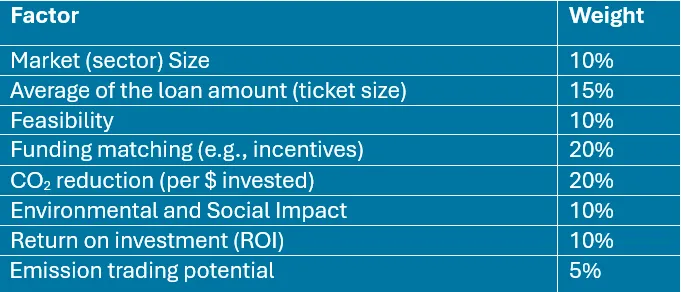
Energy-intensive sectors where SMEs operate, such as metalworking, transportation, and brick manufacturing, present significant opportunities for energy-efficient upgrades with quick returns on investment.
The table below illustrates an example of sector prioritization.
4. Understanding the Demand
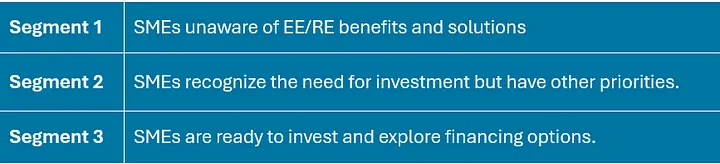
SMEs often face barriers to advance in energy transition, including limited resources, lack of knowledge about solutions, and poor understanding of cost savings and ROI. Environmental impact is rarely a priority for SMEs, and it is considered only after the immediate and tangible benefits evaluation of energy transition investment. Moreover, SME owners face competing short-term priorities that dominate their attention. In the book Scarcity, behavioral economists S. Mullainathan and E. Shafir explain how short-term challenges consume mental bandwidth, keeping individuals in “firefighting” mode and leaving little room for long-term critical planning, such as energy transition planning. Thus, market segmentation by the investment decision stage is necessary to approach the market effectively.
SME Market Segmentation by Investment Decision Stage
Strategic Market Approach by Segment
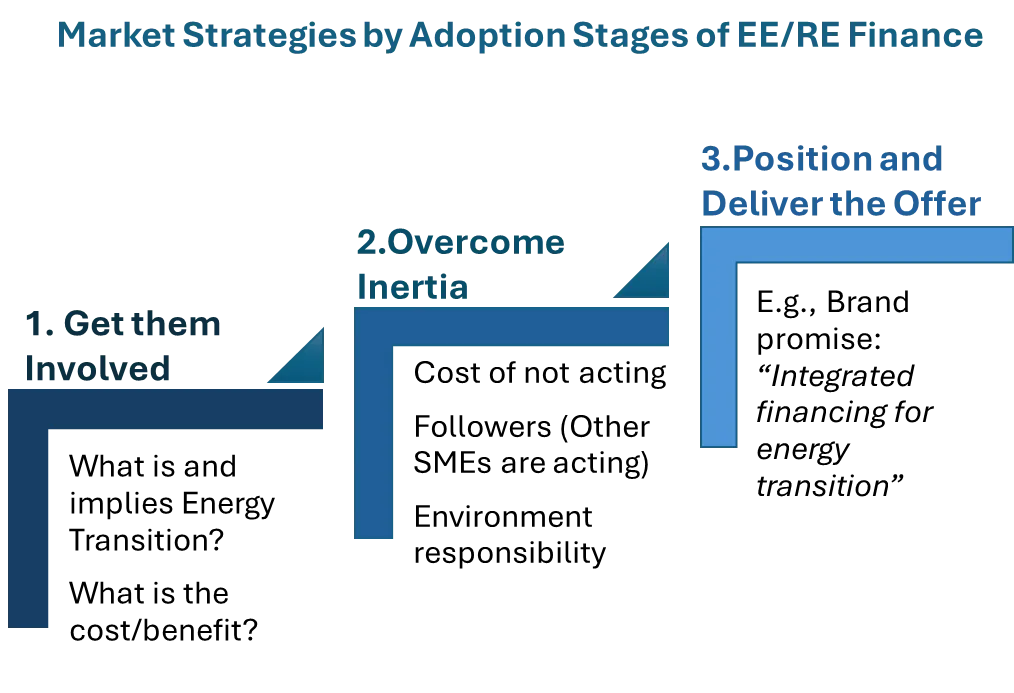
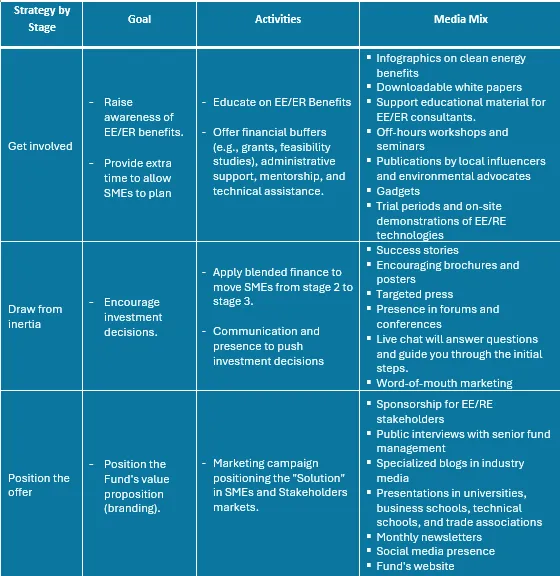
Financial institutions and funders must adopt strategies tailored to SMEs’ decision stages to develop an effective pipeline. Targeted strategies by segment can help move SMEs from inertia to actively deciding on clean energy investments.
Stage 1 — Get Involved: Raise awareness of EE/RE profitability and provide information on solutions to help SMEs make informed investments without disrupting operations.
Stage 2—Overcome Inertia: Emphasize investment urgency and competitive pressures (e.g., “Other peers already did it”). Blended finance can help SMEs move to Stage 3.
Stage 3—Position and Deliver: Present the financing offer and position the brand as the go-to partner for sustainable finance solutions. To compete with other FSPs, emphasize value-added services like technical assistance. Blended finance may not be as critical as in Stage 2, as SMEs are already prepared to invest.
Summary
Moving Forward
Funders, banks, and other financial service providers must collaborate to develop the SME market for energy transition finance. Financial service providers can build a robust, sustainable pipeline of deals by prioritizing high-impact sectors, understanding SMEs’ decision-making processes, and implementing targeted strategies for each adoption stage. This effort will foster a vibrant EE and RE finance market while advancing net-zero climate goals.