


Research Agenda for Customer-Centric Financial Services
Putting People at the Center of Financial Systems
The Core Idea
Consumer research is essential for breaking down barriers to financial inclusion. It ensures financial services align with real user needs, especially those of underserved populations.
The Gap
- Regulators focus on systemic risk
- Financial institutions focus on research leading to business growth
- The missing link: In-depth, consumer-centric research as a driver of customer well-being.
We need researchers, innovators & academics to bridge the gap by exploring needs from the ground up.
Key Research Themes:
- Over-indebtedness
- Financial literacy
- Consumer Understanding
- Cost & affordability
- Payments systems and digital money
- Product innovation
- Building ecosystems for tokenization and decentralized finance
- Environmental & consumer protection
Key Research Areas and Some Key Questions
1. Over-Indebtedness
- Hidden from regulation, but a top stressor for users.
- Explore: debt burdens, loan carousel risks, sales practices, forecasting tools.
2. Financial Literacy
- What behaviors can education really change?
- Which mental models and teaching methods work best?
3. Consumer Understanding
- Deep dive into behaviors by product, market, and segment
- Use meta-analysis to mine existing studies
4. Cost of Financial Services
- Do users understand real borrowing costs?
- Customer's opportunity cost from microlending
- Compare cost benchmarks across markets
5. Payment Systems
- Explore adoption drivers: convenience, trust, rural access, agent networks
- Explore adoption and challenges of digital money
6. Emerging Products
- Driven by tech, demographics, and climate
- Address niche markets challanges and scale solutions
7. Decentralized Finance (DeFi)
- Tokenization of low-income populations’ assets to unlock liquidity and dormant capital
- DeFi echoes ROSCAs (rotating savings and credit associations), an informal financing practice widely used by low-income markets
- Research: trust, security, barriers, protections, digital literecy
8. Environment & Consumer Protection
- Combine ESG & consumer protection
- Study: user demand, regulation models, climate awareness
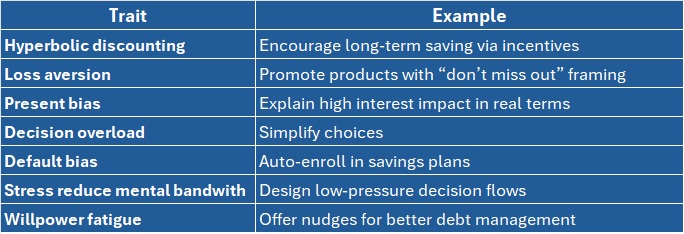
Behavioral Economics in Action
Understand how biases shape financial choices:
In Summary
Consumer-centered research + behavioral insights + technolosy disruption = More inclusive, relevant, and empowering financial services.
This updated analysis is based on a previous report on Methods to Measure Clients Satisfaction witn Financial Services