


Understanding Rural Financial Behavior: Insights to Guide Financial Services Innovation
A look into how savings, credit, and insurance shape the financial livesof rural clients—and what that means for product design
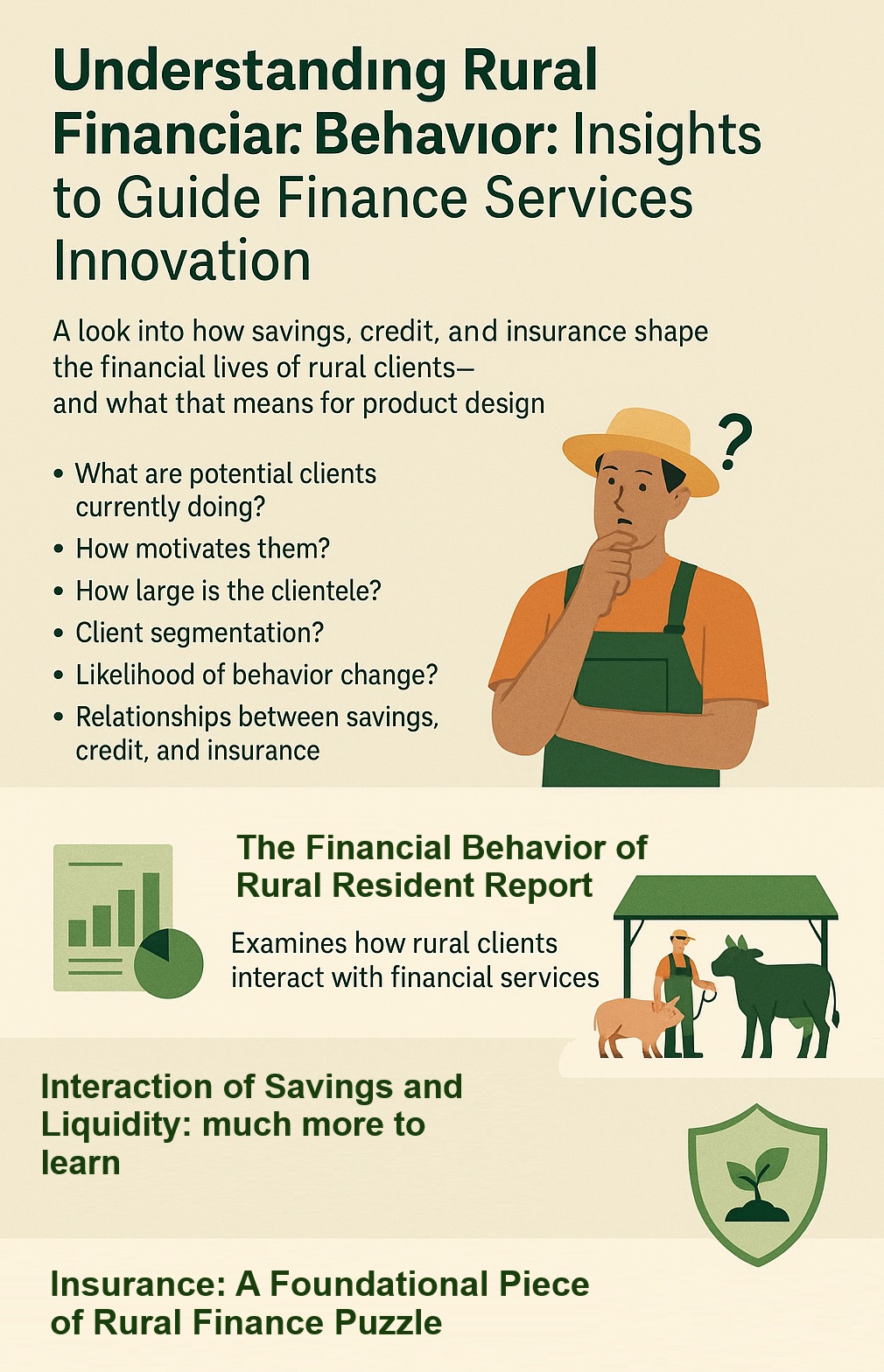
Microfinance institutions (MFIs) face many questions when developing newfinancial products. What are potential clients currently doing? What motivates them? How can we segment clients into meaningful groups? How large is the potential clientele? Are there enough prospective users to justify launching anew product? How likely are clients to change certain behaviors? And what are the key relationships between savings, credit, and insurance?
Answering these questions is essential for designing products thatrespond to real market needs and are economically viable for institutions. My research, Financial Behavior of Rural Residents explores these questions by examining how rural population interact with financial services.
The purpose of the study was to compile insights on consumer behaviorinto a single resource that MFIs can use to map consumer beliefs, informproduct development and marketing strategies, and set KPIs.
Savings Behavior and Concept of Liquidity: Much More to Learn from Rural Households
Some findings were particularly eye-opening. For example, the amount rural residents save is more closely tied to the purpose of their savings than to their income level. This underscores the importance of understanding client goals when designing savings products. Another key insight is the level of commitment to saving, which may serveas a useful metric for profiling different savings markets. In our sample, 13%of clients prioritized savings by setting money aside before spending,while 60% saved only what was left over. The "save before spending"group reflects a more proactive financial mindset. From what I know of globaltrends, this behavior may be more common in parts of Asia and Africa.
In addition, the way clients save varies greatly. While we often assume savings happen gradually, around 25% of participants reported saving in large lump sums—typically from seasonal income like crop sales. The study also reveals a pressing need to improve credit offerings for rural markets. Many potential clients combine credit and savings strategies to meet their objectives.
During a visit to a livestock market in rural Colombia, I was struck by the parallels between it and a traditional stock exchange—except here, cows and pigs replaced stocks and bonds.
This visit sparked ideas on how to increase liquidity in rural markets,where livestock often double as both investment and currency, and households’ current consumption typically relies on post-harvest income.
Could we explore financial tools—like factoring or warehouse receipt systems—to unlock liquidity? Could technology help transform illiquid assets into more liquid resources?
Insurance: A Foundational Piece of the Rural Finance Puzzle
Insurance plays a crucial role in the success of other financial products,especially in agriculture, where risks are high. It enables households to take credit and make long-term plans. With accident insurance, for instance, families may feel more comfortable reallocating emergency savings toward investments.
My hope is that others will build on these findings and continue exploring how financial service providers can better meet the needs of rural clients. There’s much more to uncover about how people manage their financial lives—and even more opportunities to serve them better.